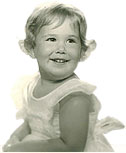
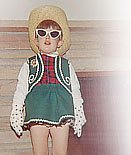
Q: What were you like when you were little? My mom was a great journal keeper, so I know from her journal entries I was a precocious, outgoing child with a flare for the dramatic. By the time I was two and a half I was singing songs from beginning to end. One day, when I was just over two years old, the neighbors were talking about me and one of them commented to the other, "Isn't she fat?" That's when I piped up and said, "That's cause I eat so good!"
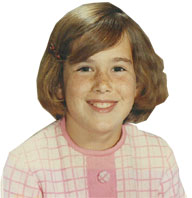
Q: What kind of things did you like to do when you were in elementary school? I liked to go outside, play soccer, swim in my pool (I lived in California), roller skate, and play football or baseball with the neighborhood boys. I had 5 brothers (no sisters) and anything my brothers did, I tried to do better.
Q: Did you like to read as a child? I would have been labeled a 'reluctant reader' when I was in grade school. I didn't sit still long enough to read when I was a child. I can clearly recall my mother reading to me when I was young though. I enjoyed listening to her make stories come to life with her dramatic inflection and exciting interpretations, but I didn't actually discover the thrill of independant reading until the 5th grade.
Q: What happened in the 5th grade that turned you onto reading? It was in Mrs. Hudsbeth's 5th grade class when reading first became magical to me. She made our reading group the best part of the day. We sat on the floor in a circle, on pillows, had snacks and had, what felt like, very grown-up discussions about the books we were reading. So I did the assigned reading in order to take part in the circle-time talk, and suddenly I found myself traveling through time and space with Meg and Charles Wallace in A Wrinkle in Time, struggling to find the way home with three amazing animals in The Incredible Journey, and on the hunt for coons with Little Ann and Old Dan in, Where the Red Fern Grows (three of my all-time favorite books). That was the year I discovered getting lost in a good book was just as fun and exciting as going out and experiencing something myself.
Q: What about writing? Has that always come easy to you?
(Laugh...) I was actually placed in a remedial English class when I was in the 7th grade. No, writing has not always come easily for me! I recall having to write my first story in the 6th grade. My teacher, Mr. Ward, was going to make our stories into little books. I remember the whole thing being exciting, but it was also difficult. It took me hours to come up with an idea and even longer to get the words out of my head and onto the paper. To this day I've kept that book, not because it turned out to be a great story... just the opposite actually. It is poor writing at best (in fact, my children laugh at how bad it is), but when I read that little book, it reminds me that there are few writers who are born. Talents are developed through effort and time.
Q: When did you first know you wanted to write for children?
I wanted to be a lot of things growing up: a dancer, a doctor, a criminal investigator, an actress, but writer was never on the list. While studying broadcast journalism at Brigham Young University, I took several creative writing classes that helped solidify my passion for writing. But it wasn't until after I had children of my own, and we went to the public library every week to check out huge stacks of books, that I decided I wanted to write for children. I can still recall sitting on the couch one afternoon reading to my children and thinking, "This is what I want to do when I grow up! At last, I know what I want to do when I grow up... I want to write for children!"
Q: So many of your picture books are in rhyme. What is it about poetry that you like? Who are some of your favorite poets? While in High School I took my first creative writing class and it was there I discovered my love for manipulating words, creating rhythms, conjuring up rhymes, and expressing my perceptions and ideas in poetic form. I relished the freedom it gave me as a writer; the freedom to say one thing and mean another. And I liked the fact I could write without following all the rules one normally has to use when writing. e.e. Cummings was a great inspiration to me. His poems were so individualistic, his style was so unique. I saw him as a poetry rebel because he did not conform in any way. Robert Frost was also a favorite of mine..., also Emily Dickenson.
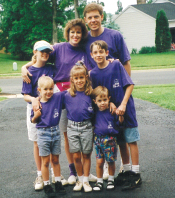
Q: What are your sources of inspiration? When my six children were growing up, they were a great source of inspiration to me. Their antics were constantly giving me ideas. They would often say or do something worth putting in my writer's journal. My bunny books are a lot like my big, crazy family. You can read them and see the inspiration coming through. I have to admit there were times I worried I would run out of ideas when my children grew up. But now I'm a grandma, and my grandchildren keep the inspiration flowing. We love to read books and make up stories together when they visit.
Q: What do you like best about being an author? The opportunities it gives me to meet children and to work with them in developing their own writing skills (I can't believe how talented kids are these days). Also, it's a pretty cool thing to hold a newly bound book in your hands; one that you've help to create. I'm always amazed when I receive the first copy of my newest book. Its like, "Wow, that's really my name on the cover!"
Q: What is the hardest part of what you do? The rejection can be very hard. I can't tell you how many rejection letters I've received. It can be a tough, painful business. But then I remember how lucky I am to be able to do what I do. Practice, persistence and patience are the keys to reaching your goals when it comes to writing. Luckily, I love the revision process and I'm willing to work at it.
Q: What motivates you to keep writing? I like the thought that somewhere, some child is reading one of my books and upon closing it he or she smiles and says, "That was a really good book". If I can help a child spend a little more of his or her day on the positive side of life, then I'll keep writing. If I can write something that enables parents, teachers and children share special moments together, then I'll continue trying to get my stories published. As saccharine as that sounds, that's my greatest motivation!
Q: What are you currently working on?
I'm always working on new picture books, but my passion project right now is a new middle grade full of adventure and delightfully funny characters.
Q: What are your hopes and dreams when it comes to your writing? Hmmmm... dreams? I certainly have big dreams when it comes to my writing; best selling picture books, novels, Newbery Award... what writer doesn't have these hopes and dreams? But I will say, when I meet some child who excitedly says, "You wrote Can You Count Ten Toes? That's my favorite book!" Or a mother writes to tell me that my book, If I Were the Wind, got her through the heartbreak of losing her baby... It's in that moment I realize, all the prestigious awards in the world couldn't be as rewarding as this.